Oratorio di San Rocco, Crespina
An immersive and individual experience through the senses.
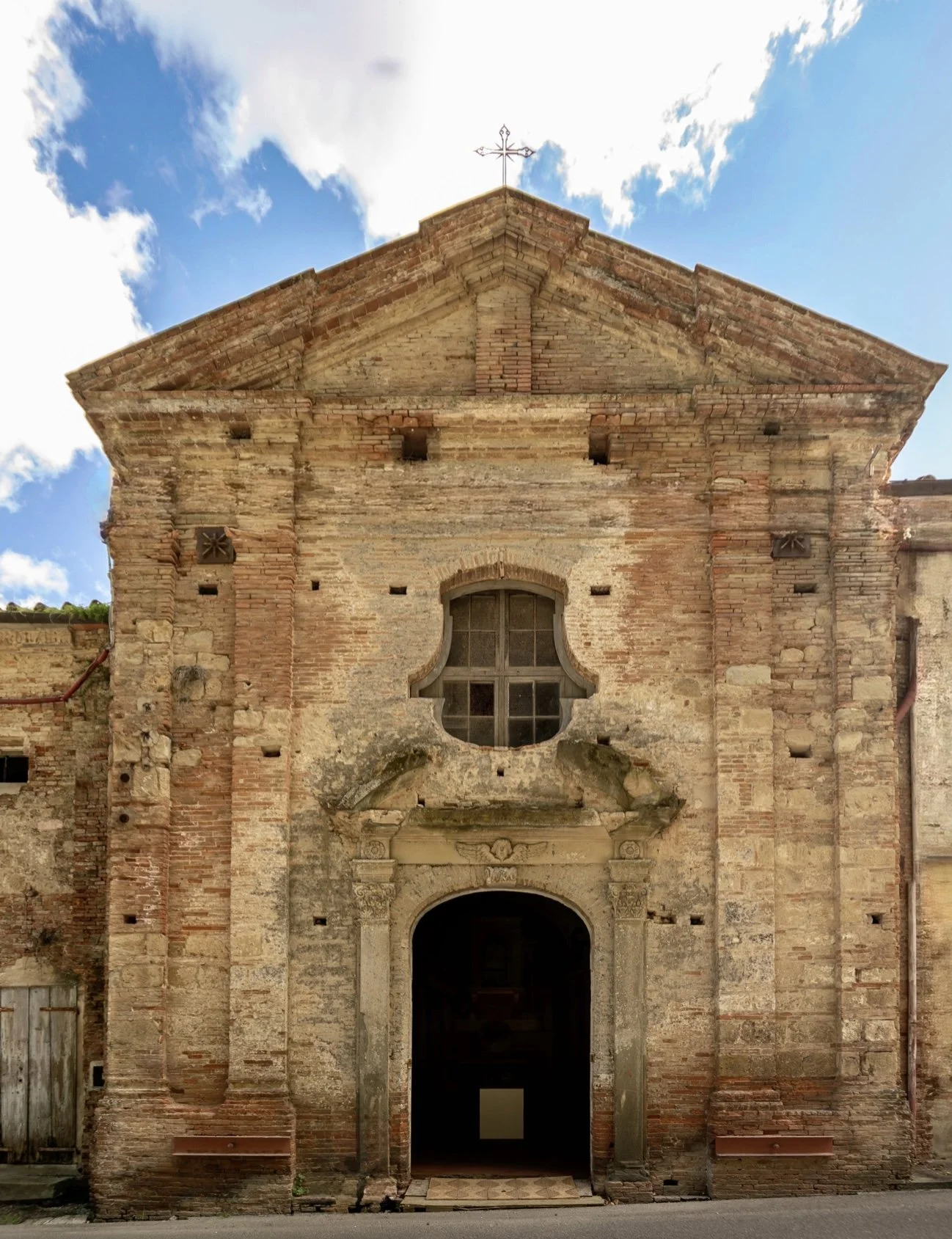
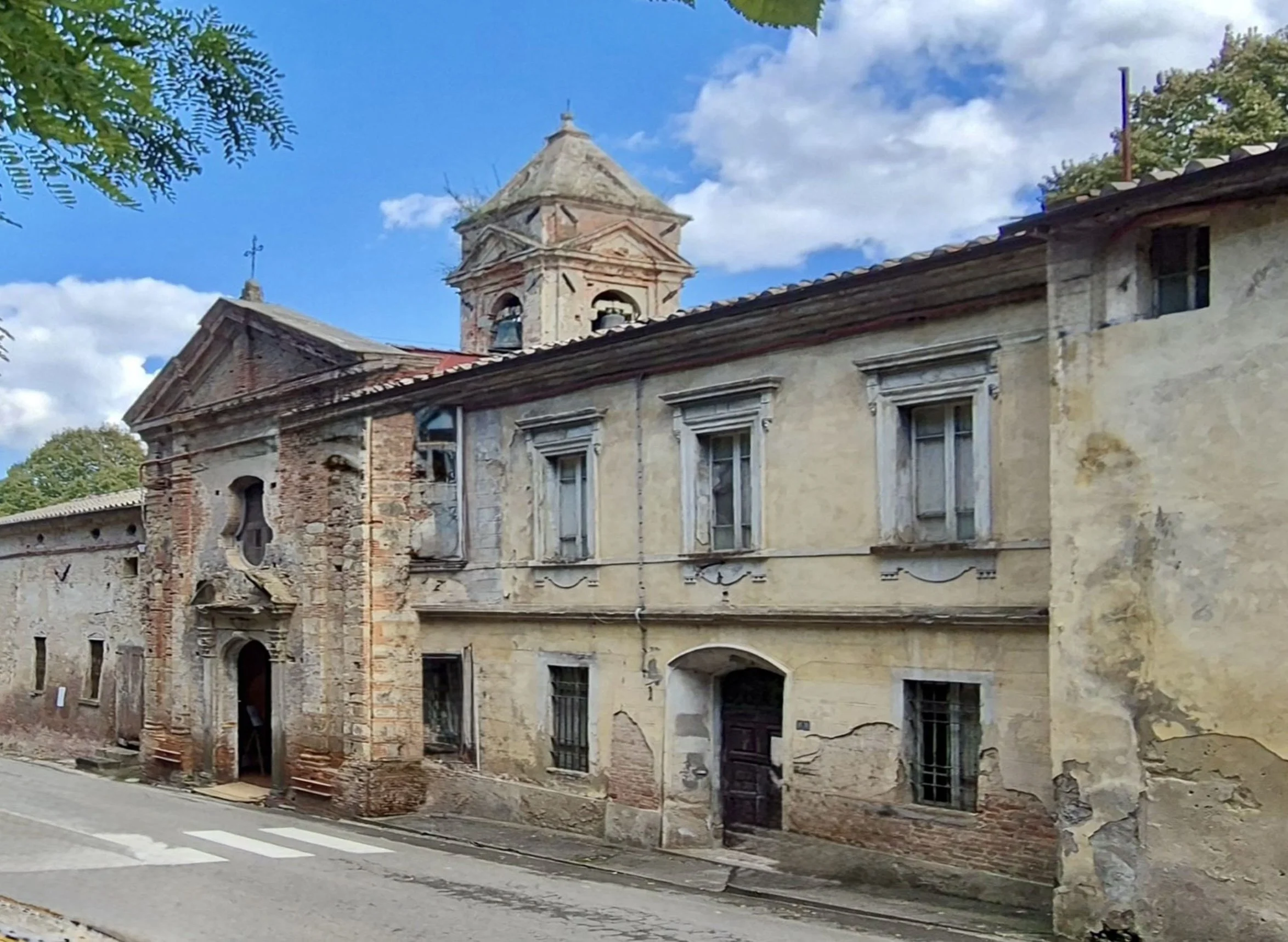
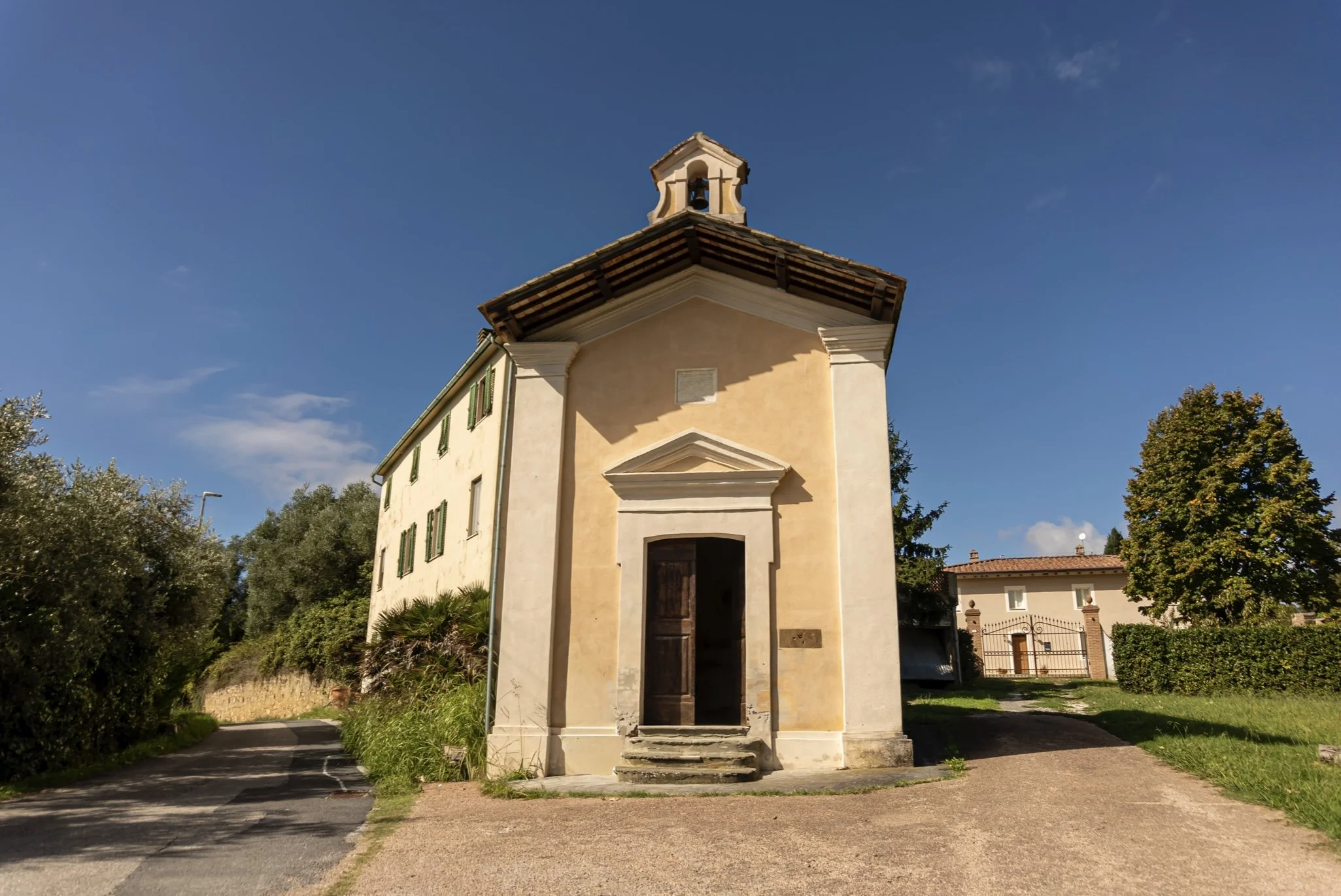
The tiny and exquisite Oratory of San Rocco was built in 1663 as an offering of thanks to God for protecting the local population from the plague and this notion of “offering” was the starting point of this multi-sensory experience created by three artists, each working in a different medium. Together they responded to this sacred place, creating a contemplative space that blended sight, sound, and smell. The different elements; visual, musical, and fragrant, carried images, sounds, and sensations which combined with the fragments of color and the damaged frescoes already present in the chapel, to create a gentle yet questioning encounter with local history and contemporary culture.
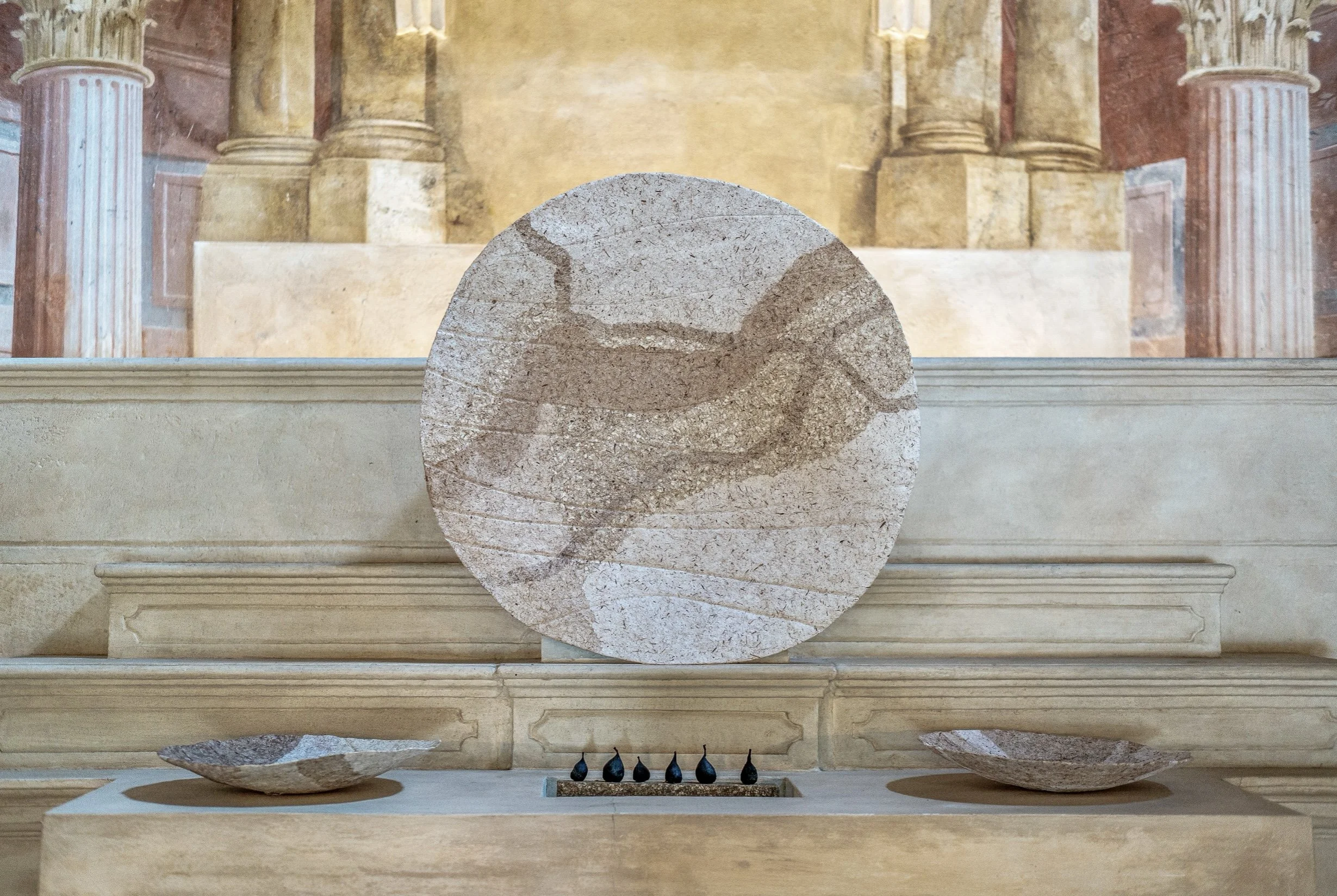
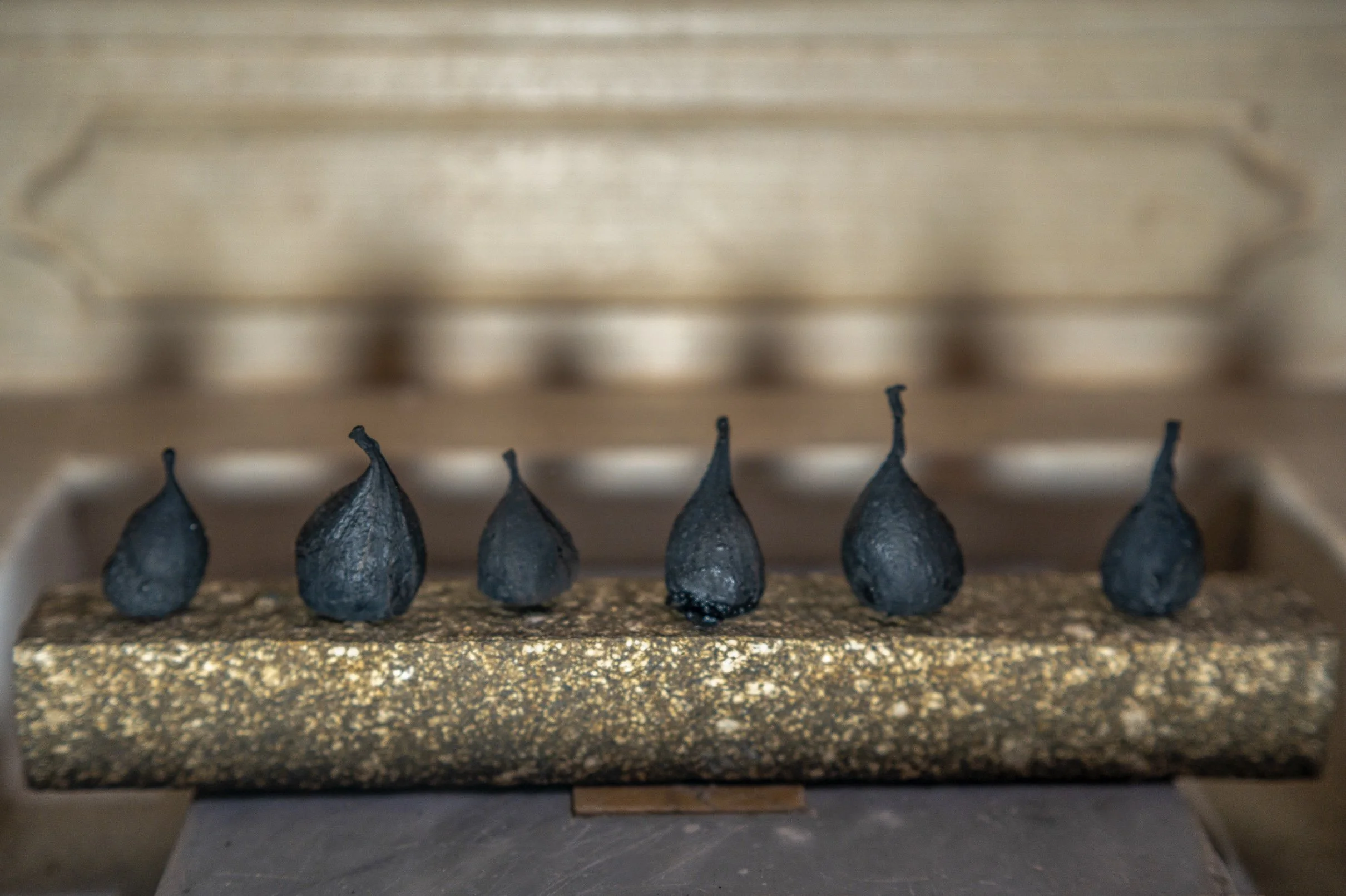
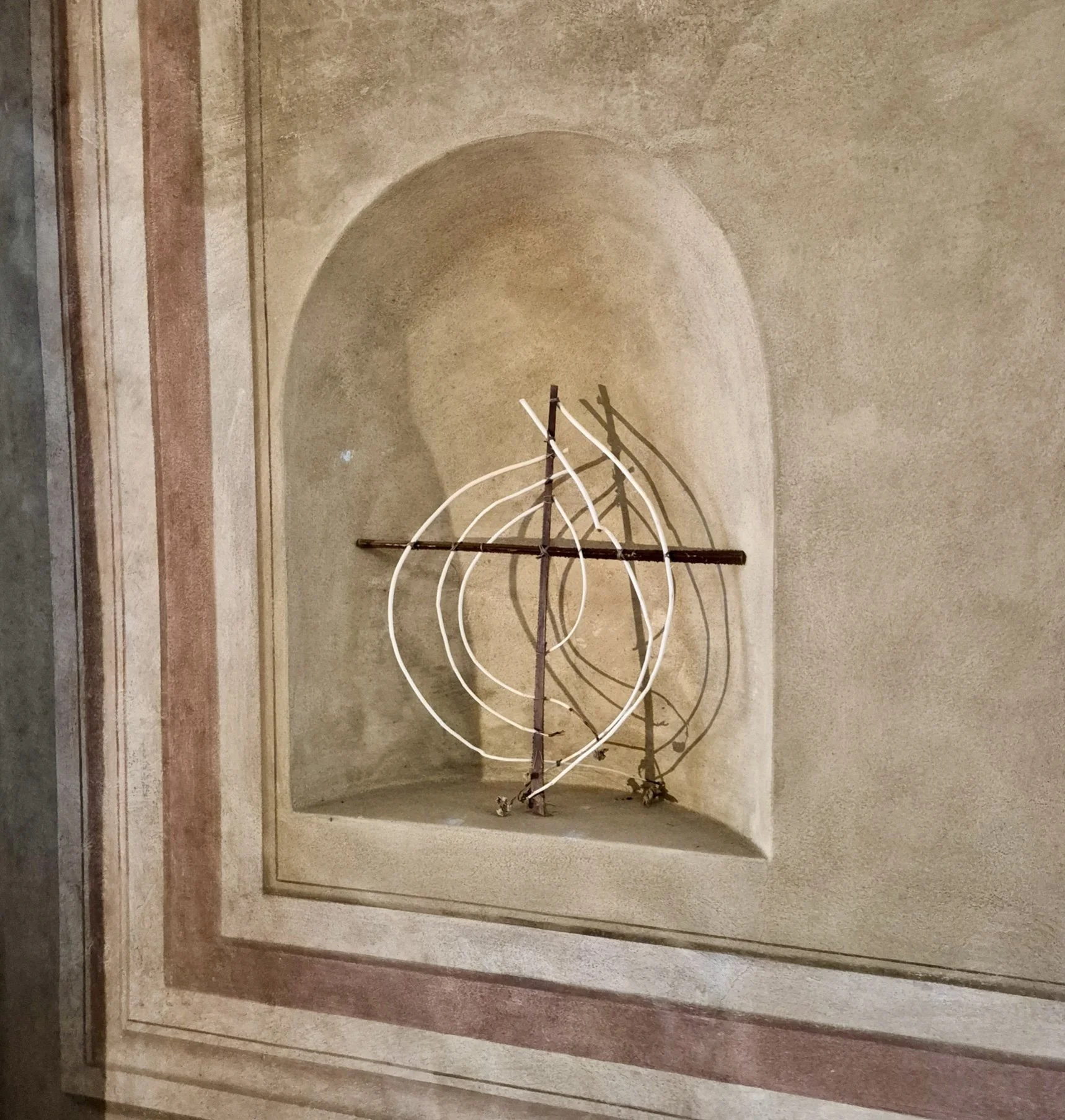
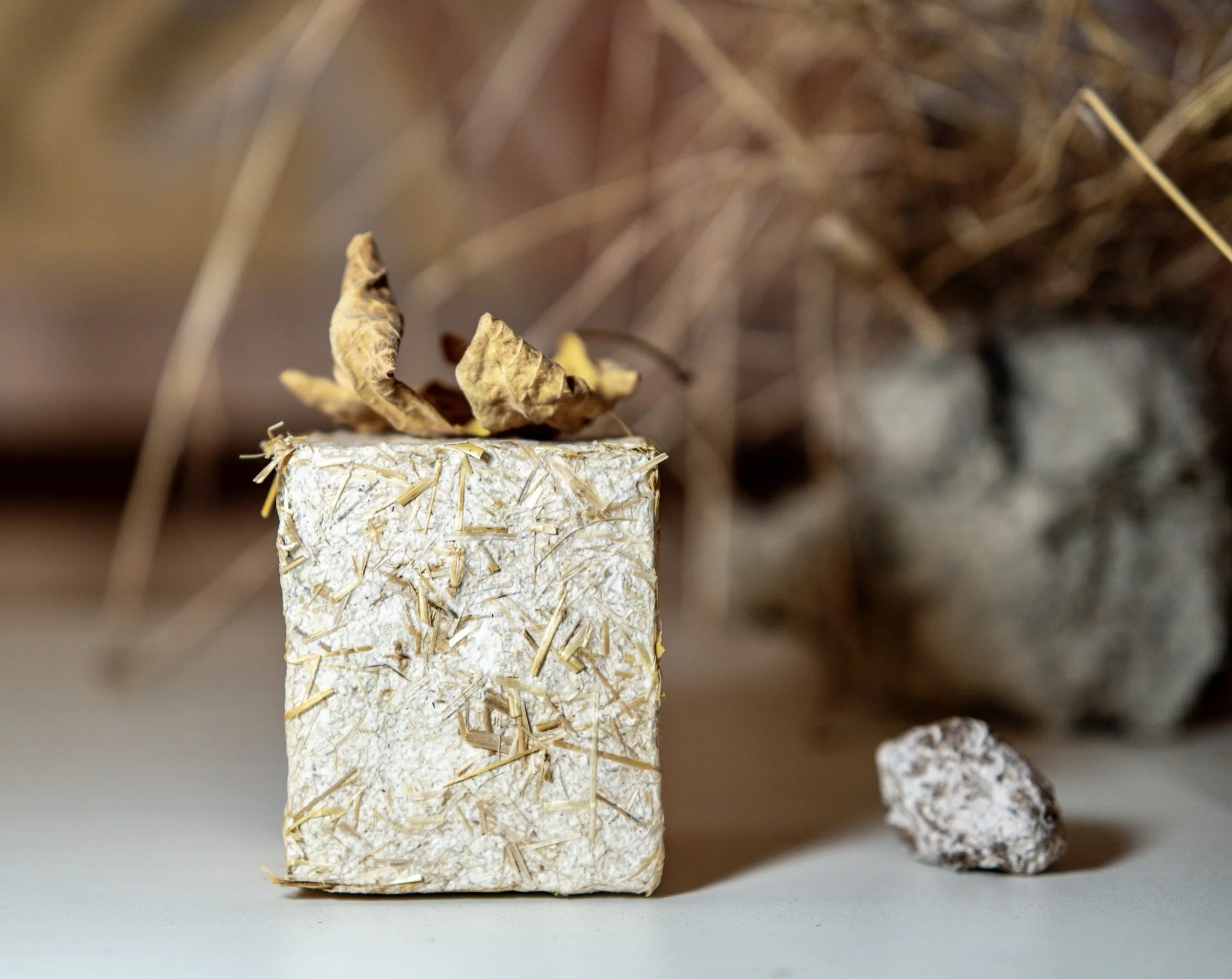
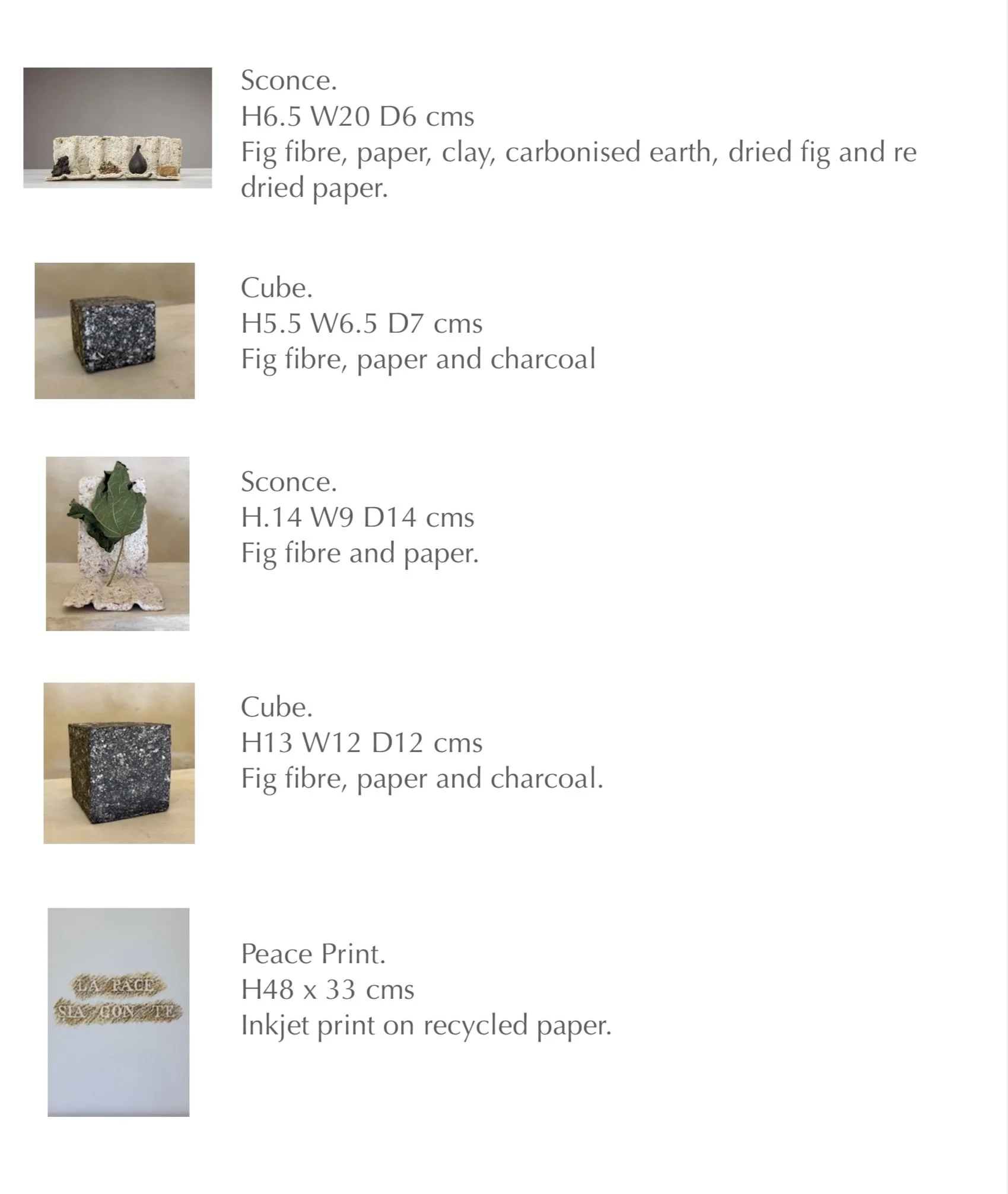
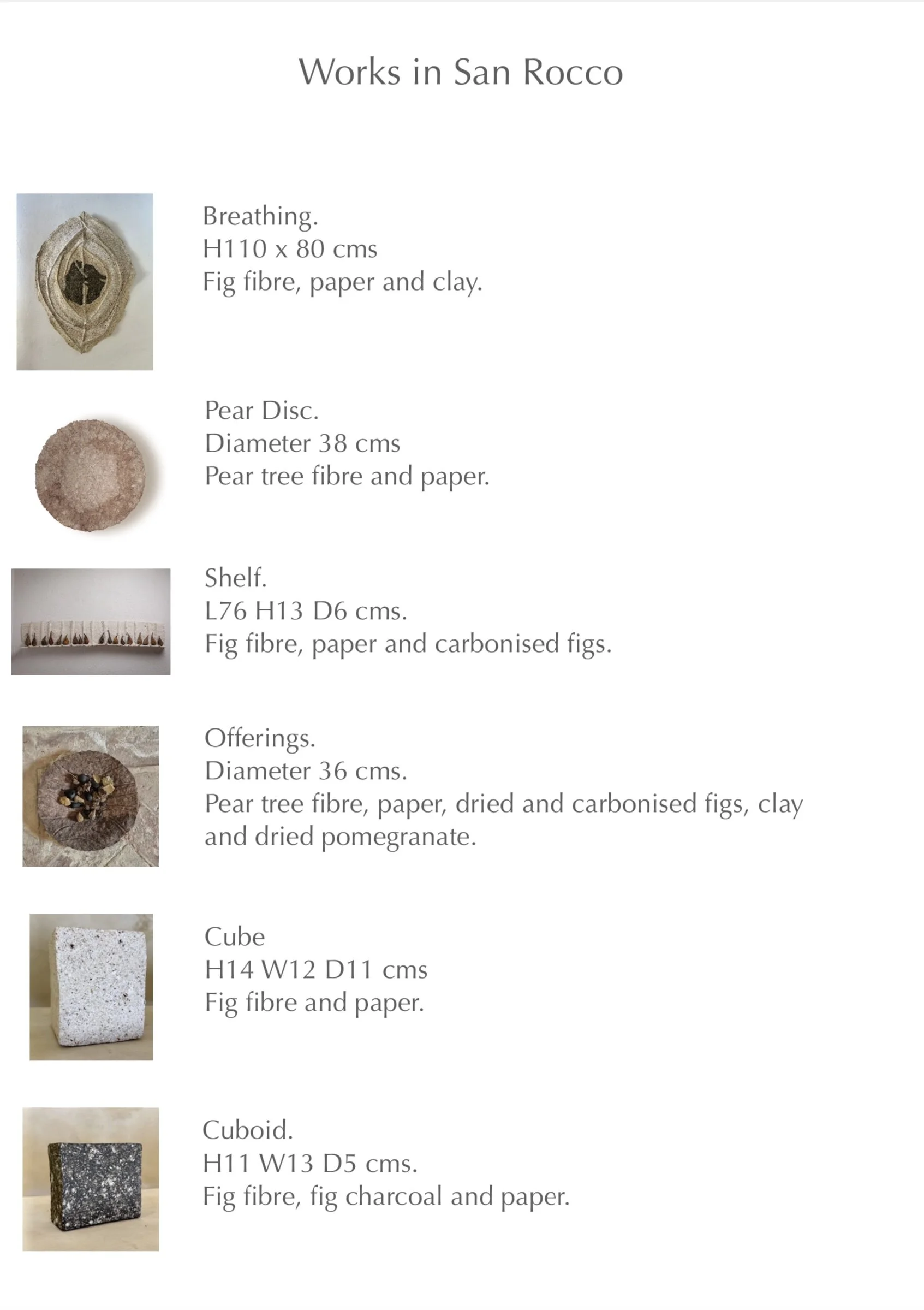
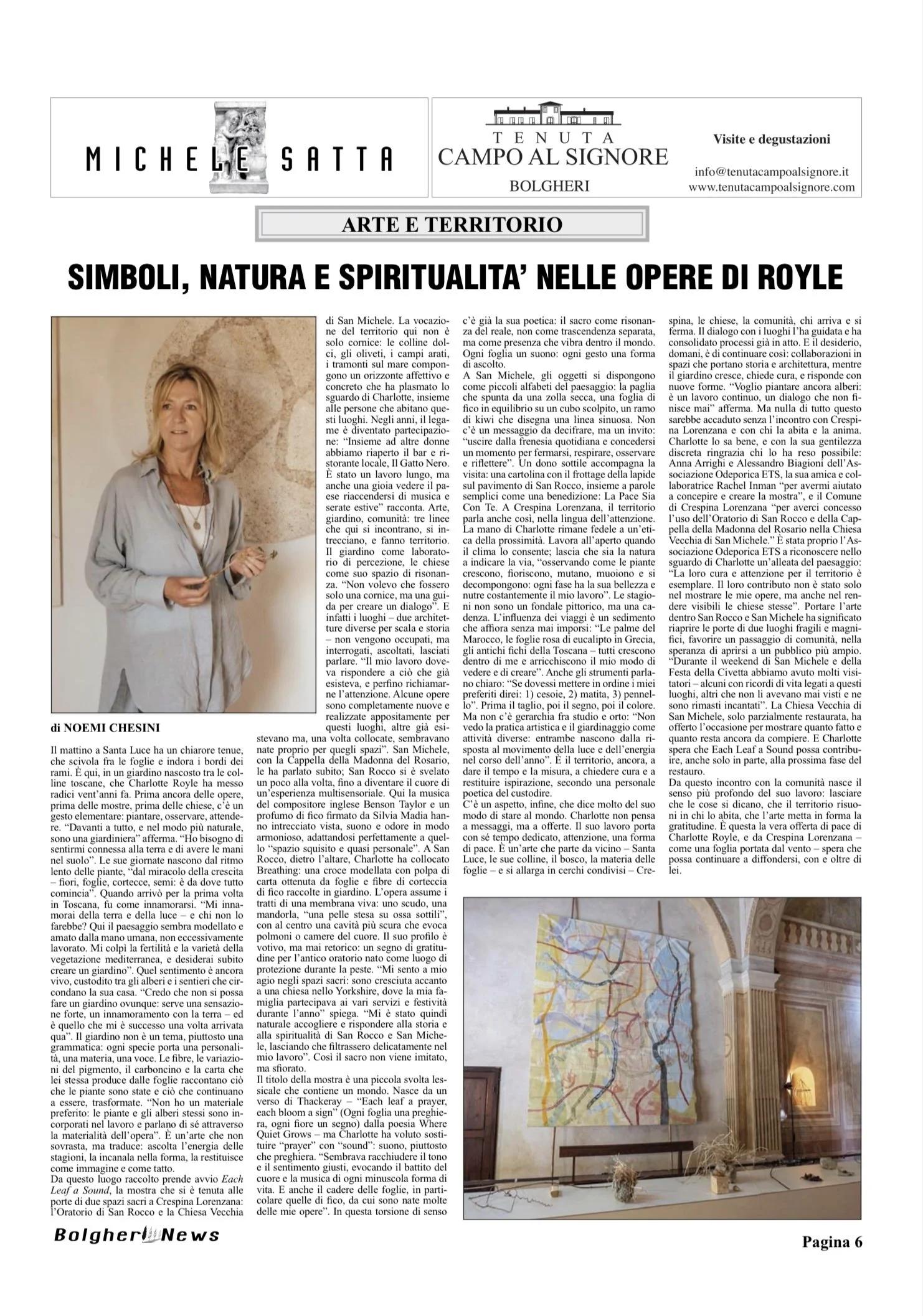
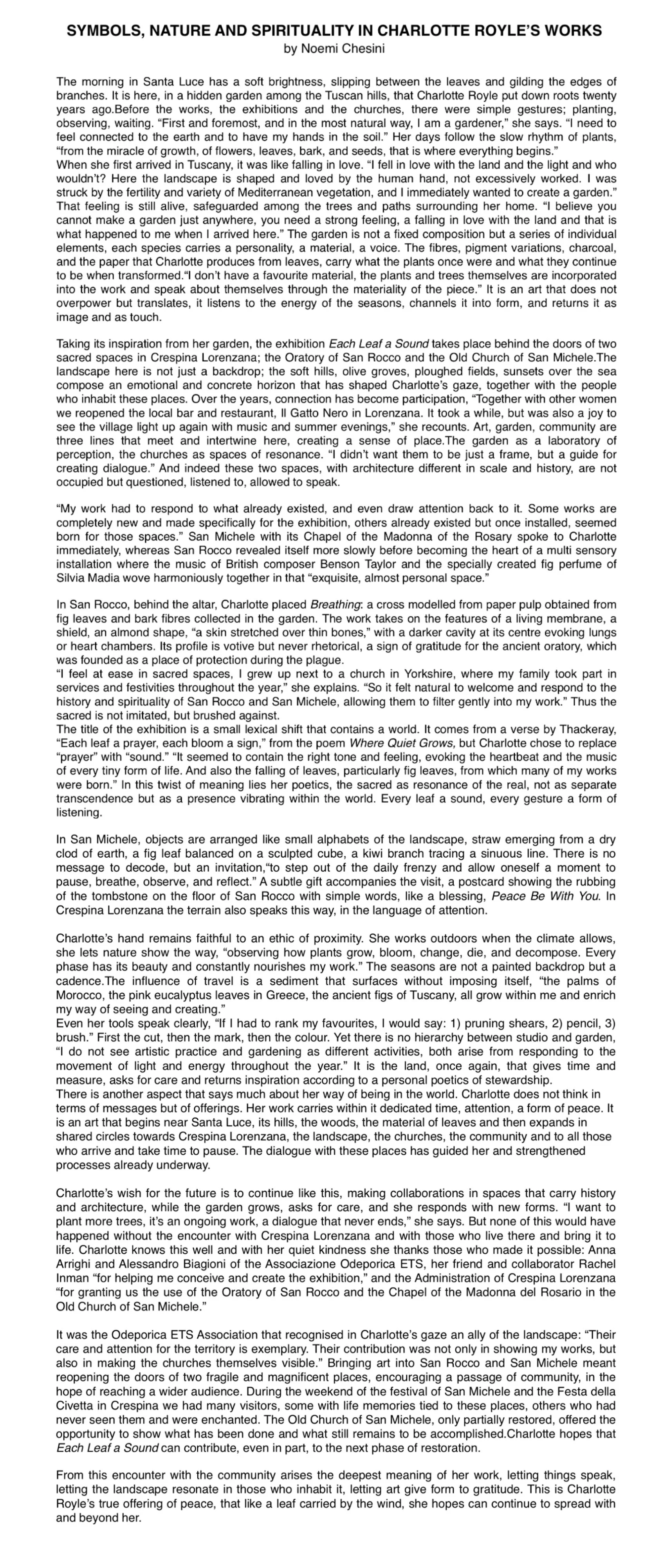
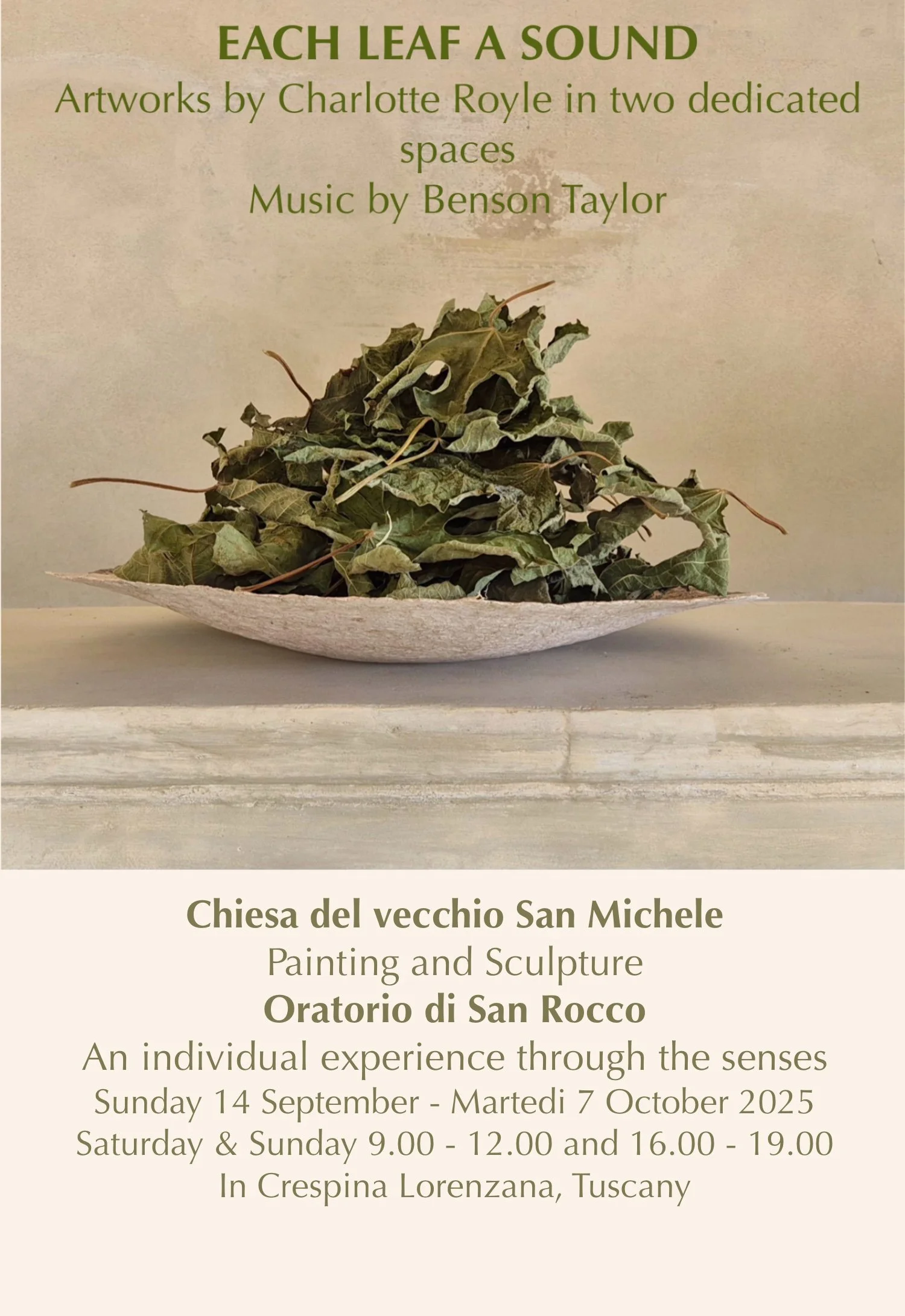
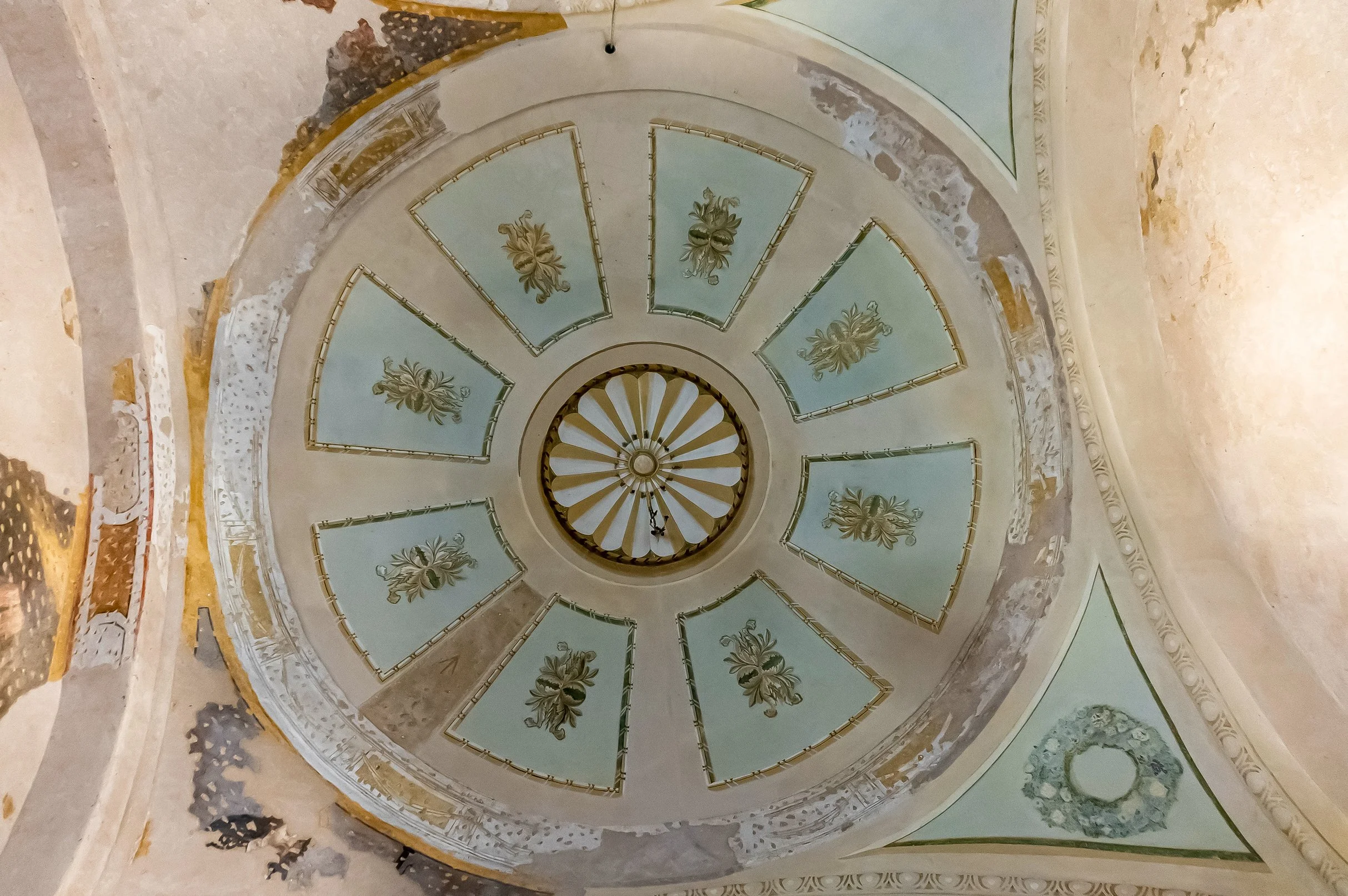
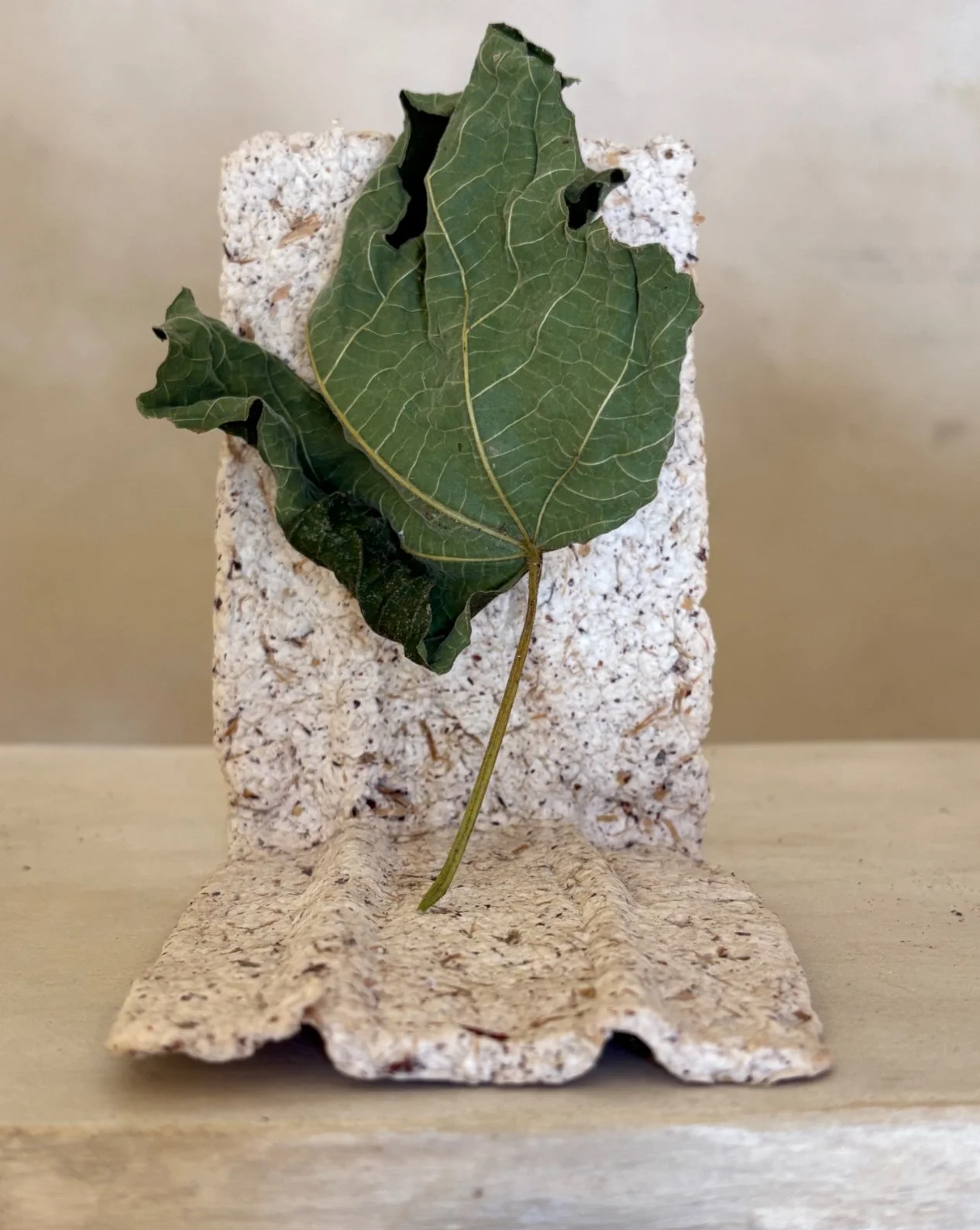
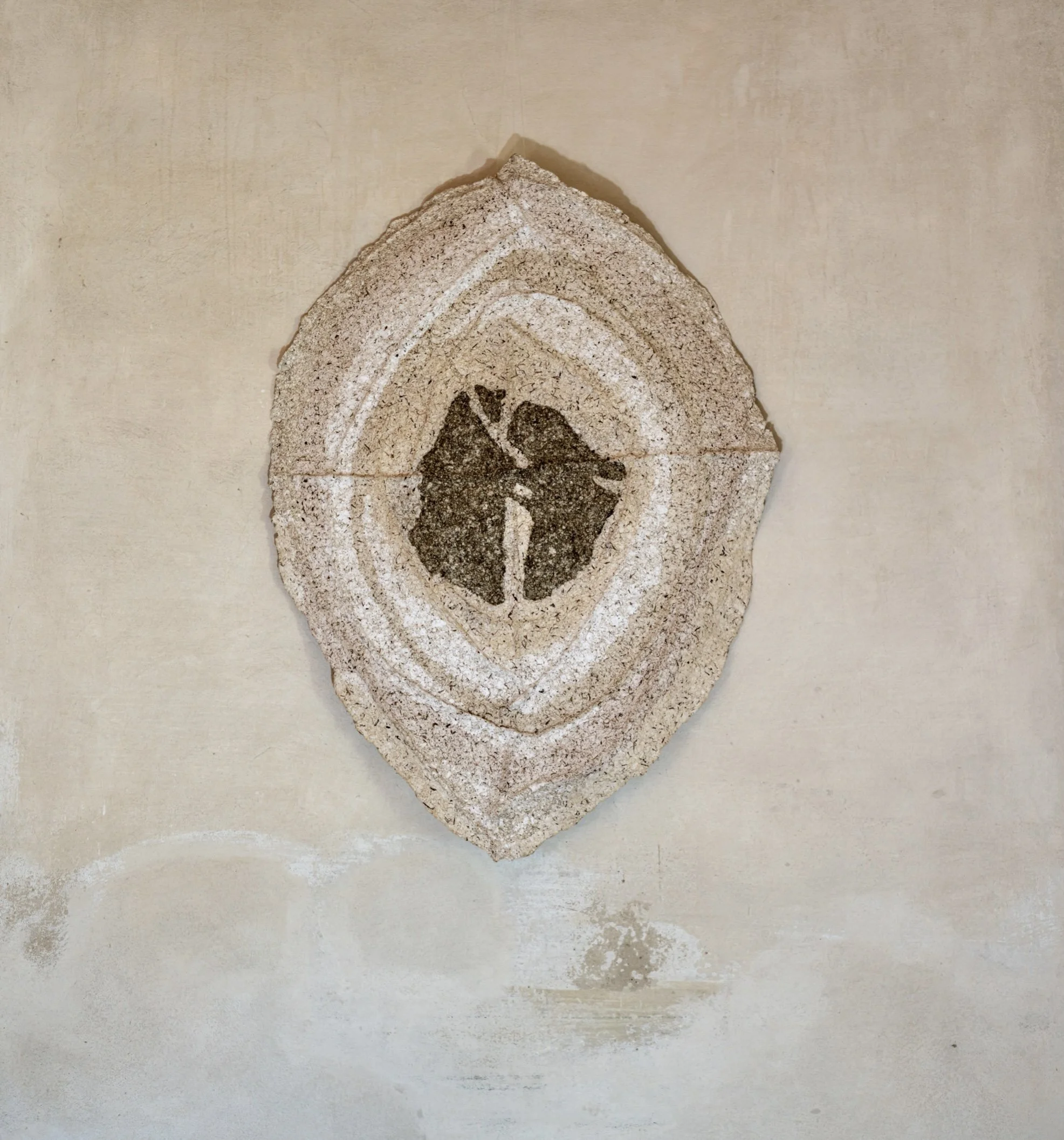
For San Rocco, Royle created a series of works based on plant fibres, including a central piece to be placed behind the altar. Aware that upon entering a church we are accustomed to seeing a crucifix, she began her work for the exhibition with a simple cross made from fig branches, which then became a delicate supporting structure from which a new form could emerge. Modelled in paper pulp obtained from fig fibres gathered in her garden, the new form recalls a shield, or the almond shape generated by the intersection of two circles, which traditionally represents creation and the union of opposites. In the centre is a darker shape, made from a mixture of fig fibres and soil from Royle’s garden, suggesting human lungs or the cavities of a heart. The title of the work is Breathing. Other smaller works displayed in the chapel included Shelf, Sconce, Cube, and Cuboid, made from various combinations of fig fibres, paper, fig charcoal, and carbonised figs.
Accompanying Royle’s works at San Rocco was a new musical composition by the composer Benson Taylor, entitled Listening to Leaves, and a fig-based fragrance specially created by Silvia Madia.
Oratorio di San Rocco, Crespina
Un’esperienza immersiva e individuale attraverso i sensi.
Il piccolo e raffinato Oratorio di San Rocco fu costruito nel 1663 come offerta di ringraziamento a Dio per aver protetto la popolazione locale dalla peste, ed è proprio questa idea di “offerta” che ha costituito il punto di partenza di questa esperienza multisensoriale creata da tre artisti, ciascuno attivo in un diverso ambito espressivo. Insieme hanno risposto a questo luogo sacro dando vita a uno spazio contemplativo che unisce vista, suono e olfatto. I diversi elementi — visivi, musicali e olfattivi — veicolavano immagini, suoni e sensazioni che, combinandosi con i frammenti di colore e gli affreschi danneggiati già presenti nella cappella, hanno creato un incontro pacato e allo stesso tempo interrogativo con la storia locale e la cultura contemporanea.
Per San Rocco, Royle ha realizzato una serie di opere basate su fibre vegetali, tra cui un lavoro centrale da collocare dietro l’altare. Consapevole che entrando in una chiesa siamo soliti vedere un crocifisso, ha iniziato il suo lavoro per la mostra con una semplice croce realizzata con rami di fico, che è poi diventata una delicata struttura portante da cui far nascere una nuova forma. Modellata in polpa di carta ottenuta da fibre di fico raccolte nel suo giardino, la nuova forma richiama uno scudo, oppure la forma a mandorla generata dall’intersezione di due cerchi, che tradizionalmente rappresenta la creazione e l’unione degli opposti. Al suo interno è presente una forma più scura, realizzata con una miscela di fibre di fico e terra proveniente dal giardino di Royle, che suggerisce i polmoni umani o le cavità di un cuore. Il titolo dell’opera è Breathing. Altre opere di dimensioni più ridotte esposte nella cappella includevano Shelf, Sconce, Cube e Cuboid, realizzate con diverse combinazioni di fibre di fico, carta, carbone di fico e fichi carbonizzati.
Ad accompagnare le opere di Royle a San Rocco vi erano una nuova composizione musicale del compositore Benson Taylor, intitolata Listening to Leaves, e una fragranza a base di fico appositamente creata da Silvia Madia.
The Old Church of San Michele, Crespina
Painting, Sculpture and Found Objects
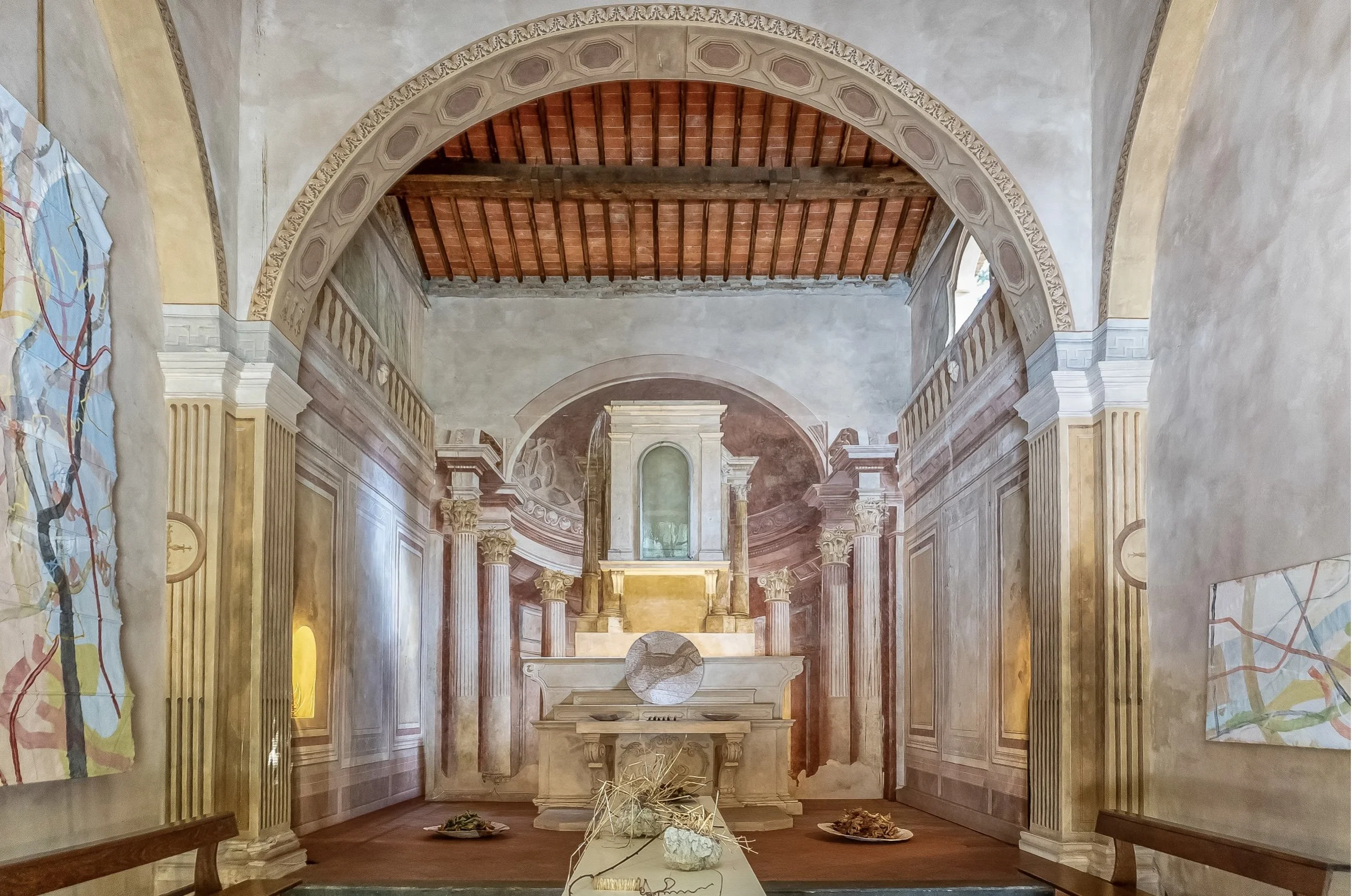
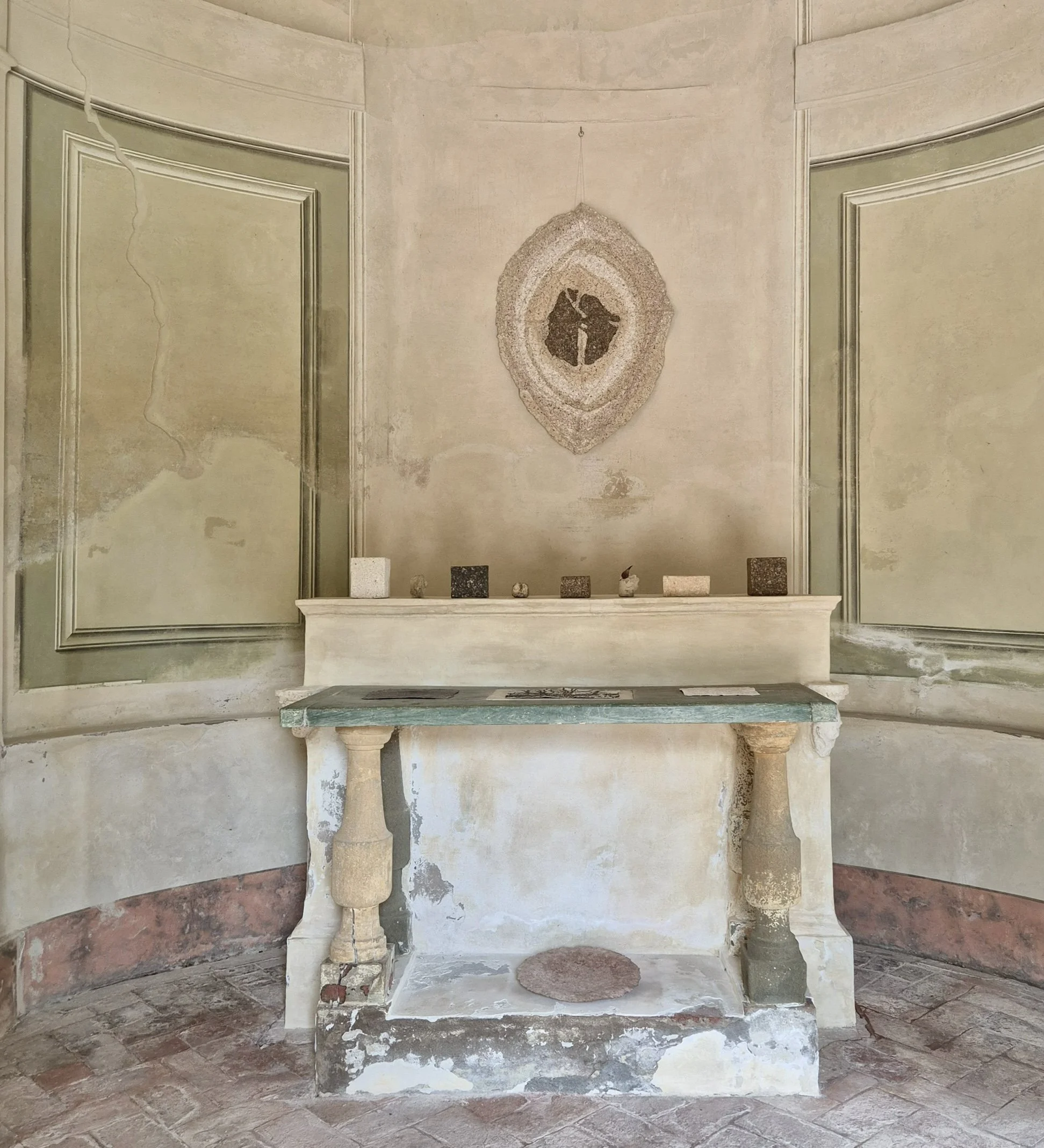
The Old Church of San Michele has a long and complex history of expansions, frescoes, collapses, and restorations. Today, the only part of the complex that has been restored and is occasionally open to the public is the Chapel of the Madonna del Rosario, located at the center. It is a beautiful space that invites the visitor into a magnificently frescoed interior, with an imposing altar surrounded by columns and balustrades painted in trompe-l’oeil by Ranieri Tempesti at the end of the eighteenth century. This sacred space, with its exceptional decoration, offered Royle a unique setting in which to place her works.
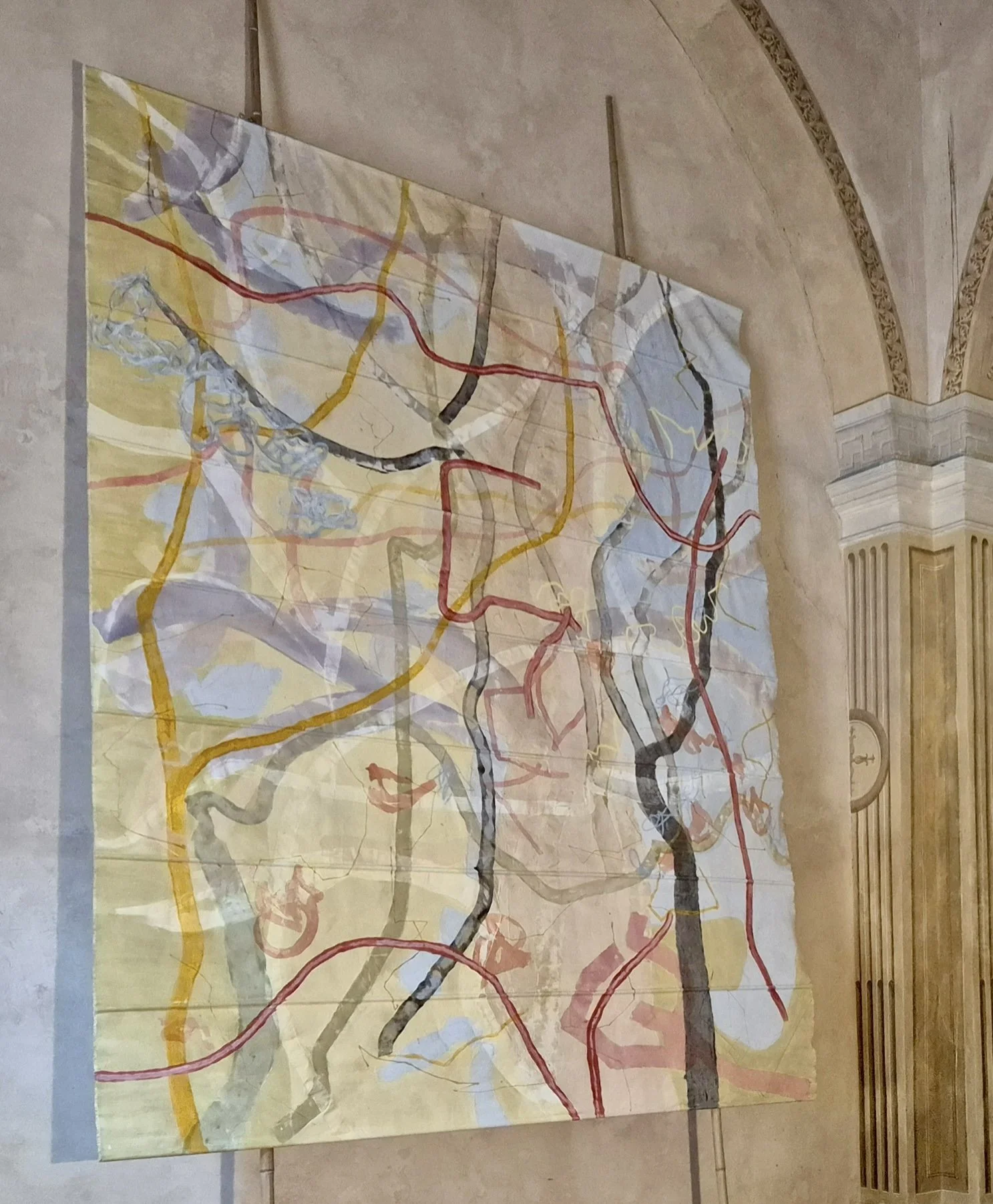
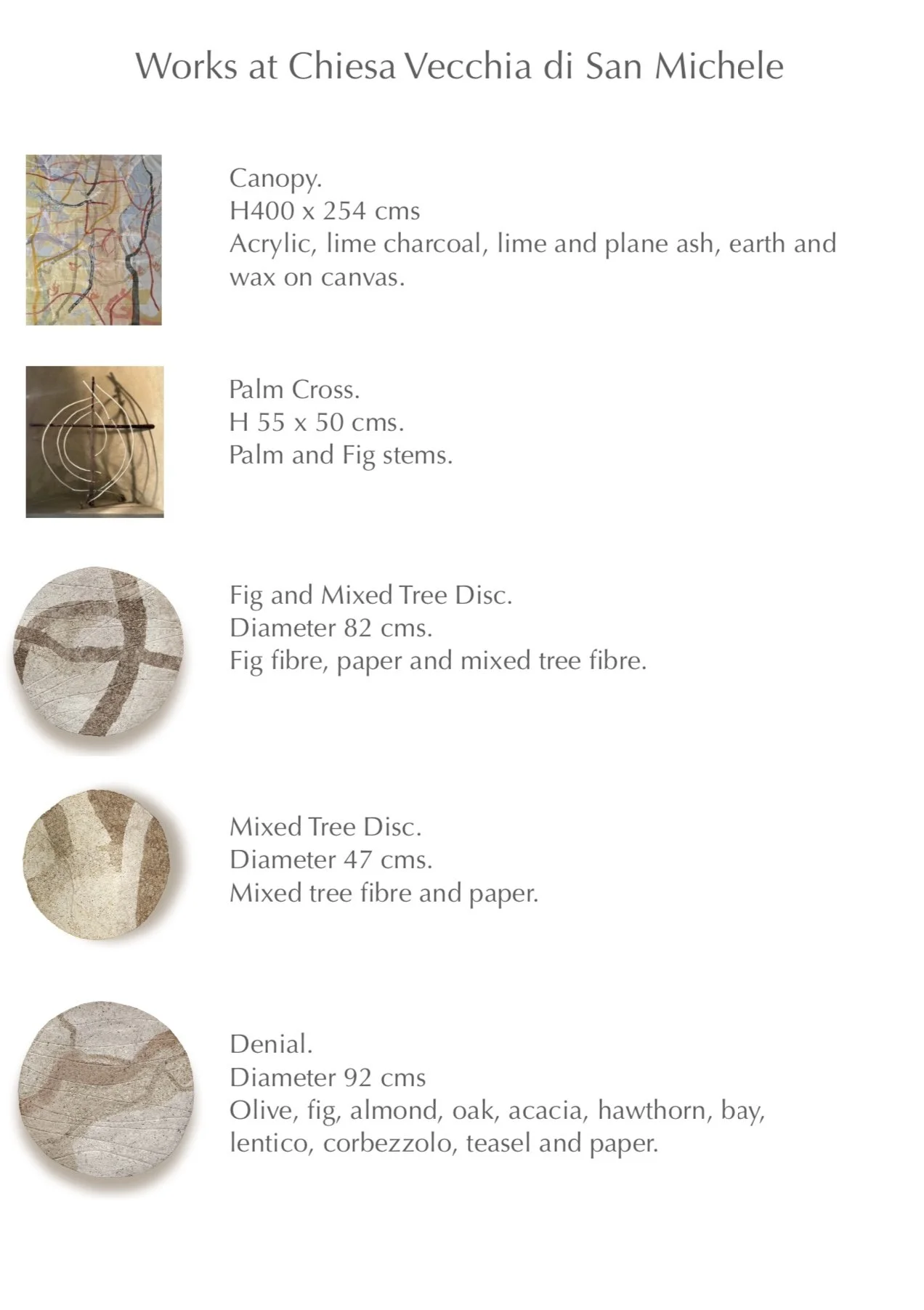
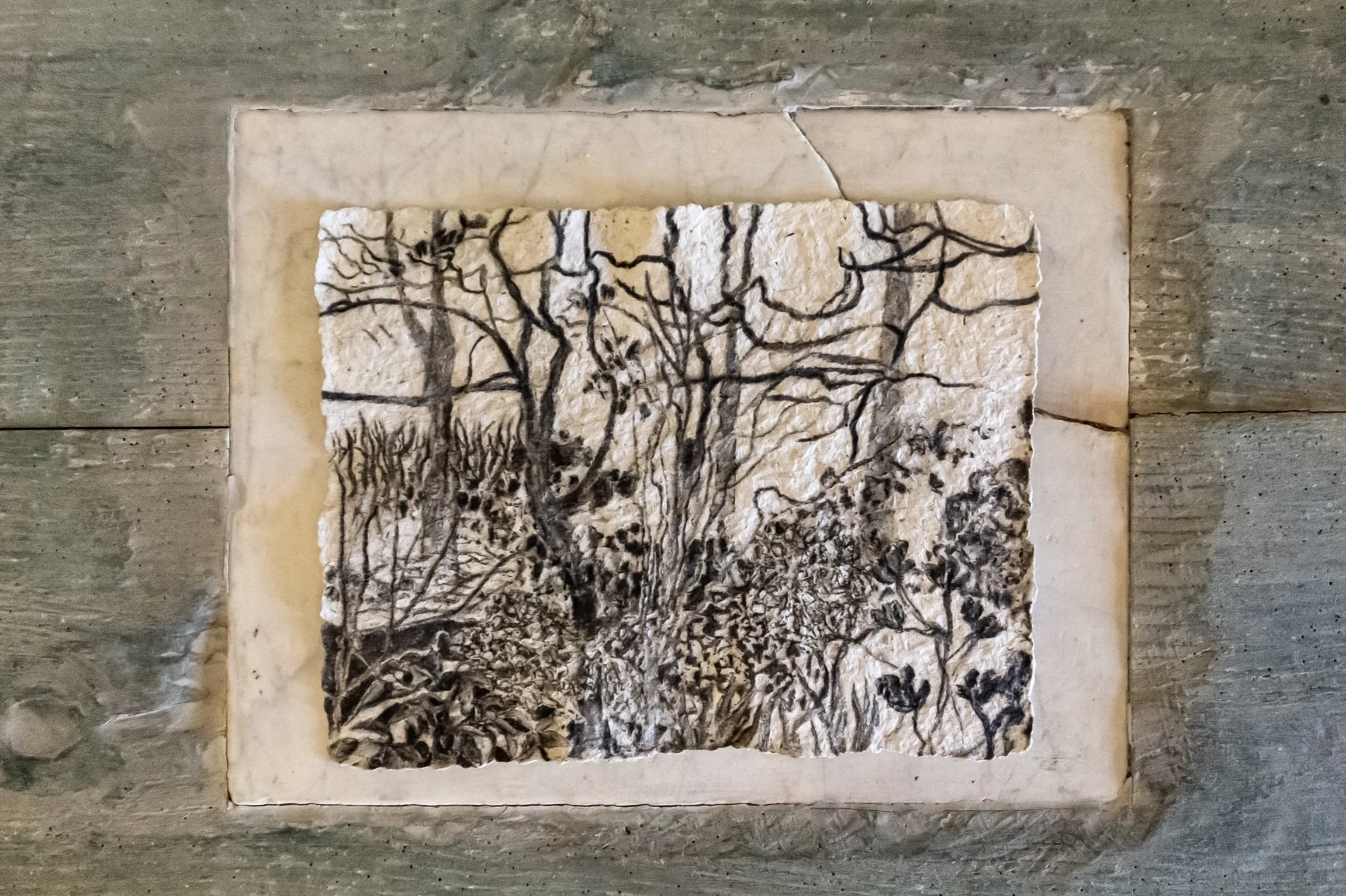
Royle created two large paintings, positioned in the wide empty arches on either side of the chapel. The larger painting, Canopy, was inspired by the lines of intertwined branches that fill the trees in her garden. Some of the darker lines come from charcoal made from fallen branches collected from the lindens and plane trees growing outside the church. Other colours were created using clay and soil gathered in Crespina, and ash derived from fallen leaves outside the New Church of San Michele, allowing Royle to incorporate natural materials from the local environment into the painting. The smaller painting, Field Lines, depicted a landscape view with soft horizons and recently ploughed wheat fields.
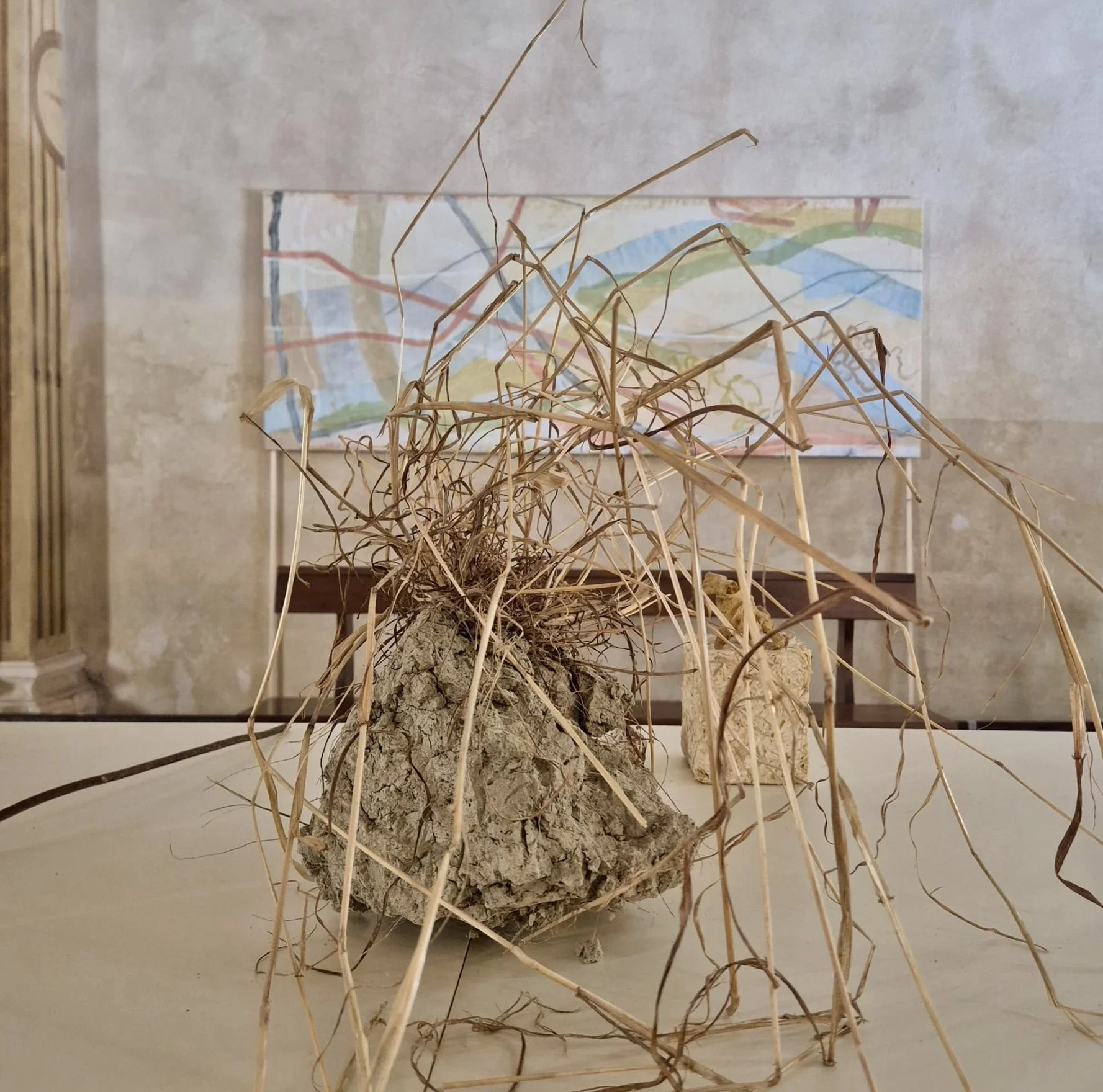
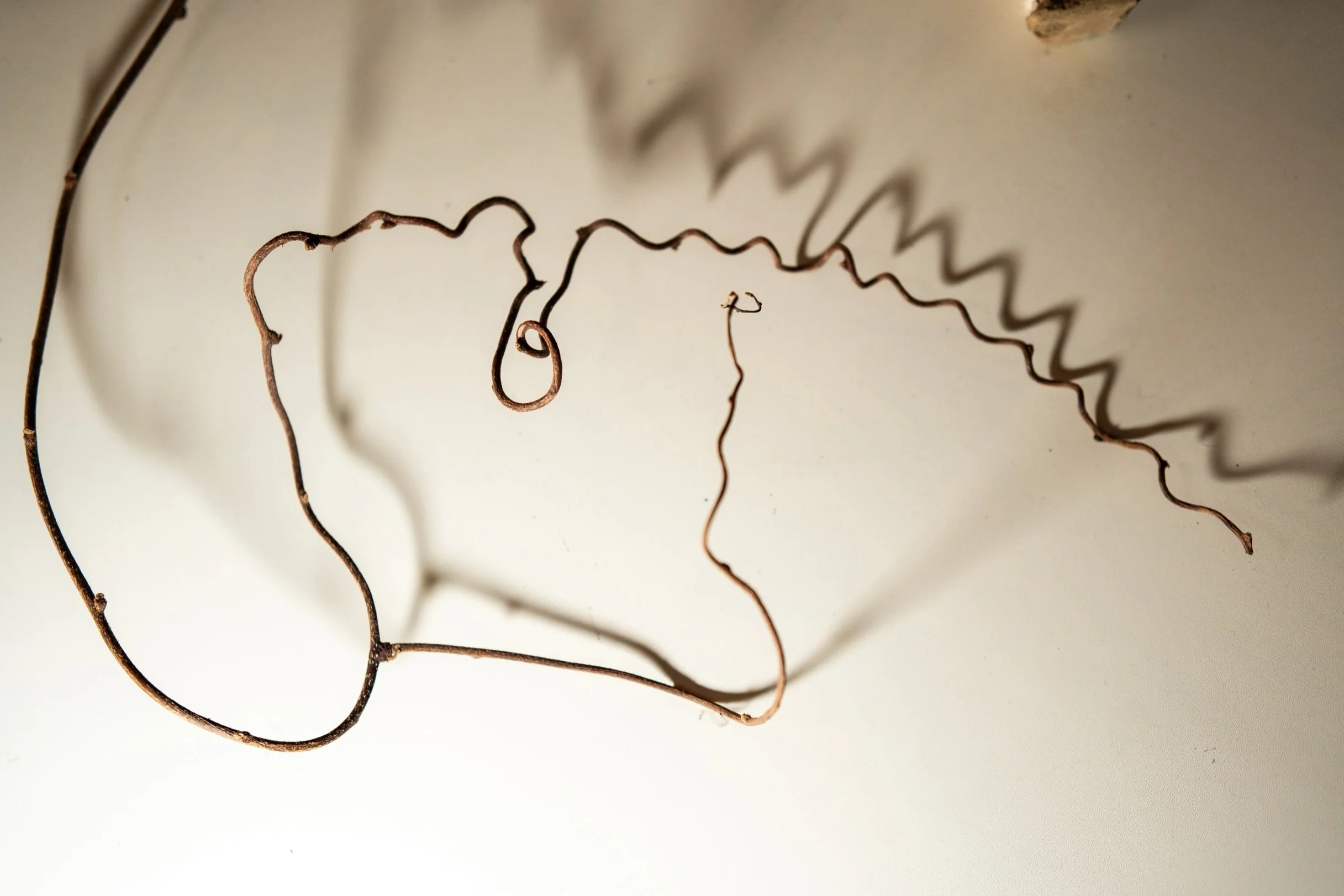
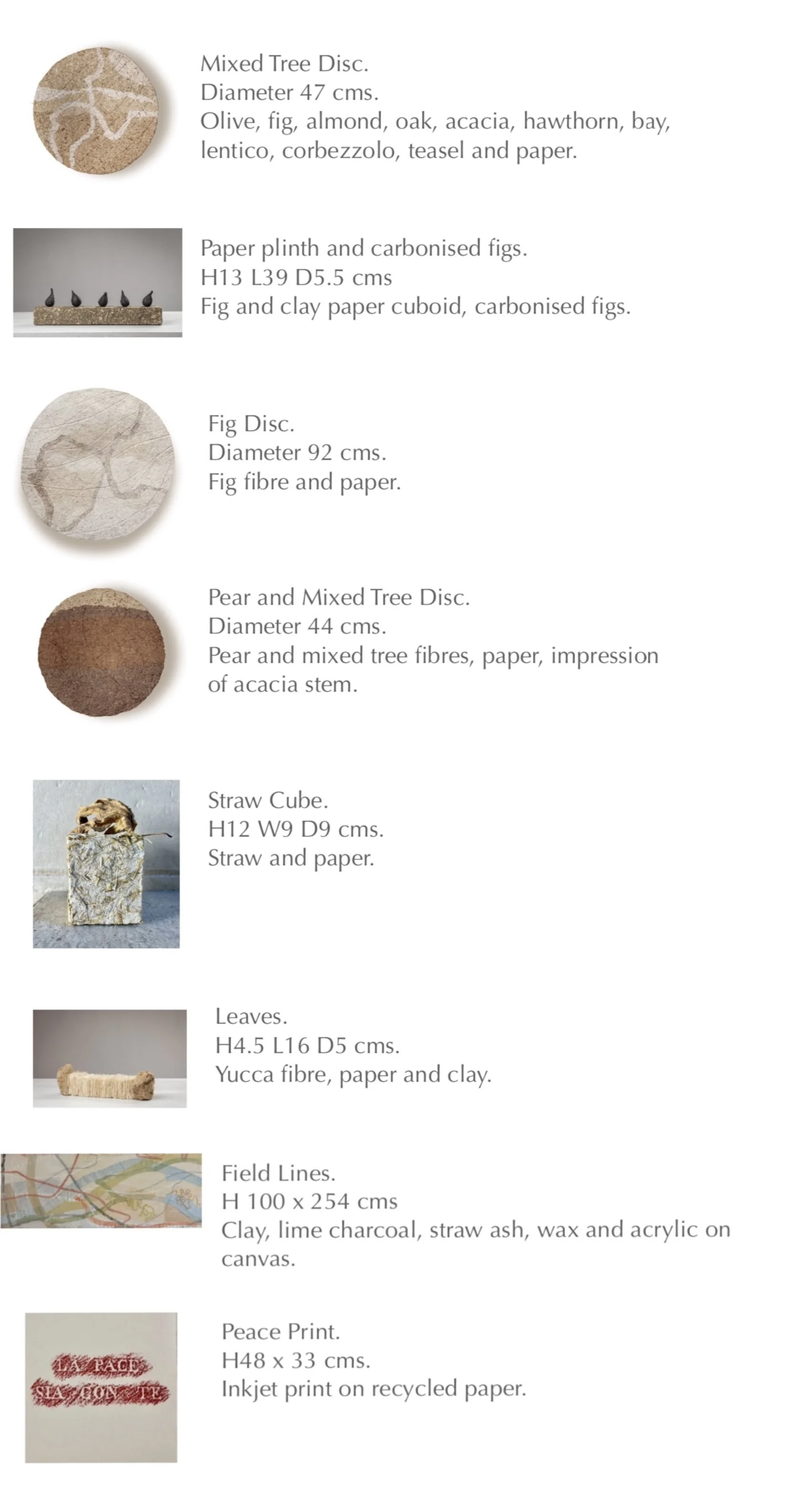
The splendid altarpiece of San Michele provided a unique context for three modelled discs by Royle, each made with a different plant-fibre. They were discreetly inserted into the architecture, drawing attention to the elegant lines and curves of the carved and painted decorations that housed them. Leading toward the altar was a long plinth supporting a collection of objects, both made and found: clods of earth still holding tufts of straw after the harvest, sinuous twigs echoing the lines of the paintings, and several smaller objects also made of plant-fibre paper.
La Chiesa Vecchia di San Michele
Pittura, Scultura e Oggetti Trovati
La Chiesa Vecchia di San Michele ha un passato lungo e complesso, fatto di ampliamenti, affreschi, crolli e restauri. Oggi l’unica parte del complesso restaurata e occasionalmente aperta al pubblico è la Capella della Madonna del Rosario, situata al centro. È uno spazio bellissimo che invita il visitatore in un interno magnificamente affrescato, con un altare imponente circondato da colonne e balaustre dipinte a trompe l’oeil da Ranieri Tempesti alla fine del Settecento. Questo spazio sacro, con la sua decorazione eccezionale, ha offerto a Royle una cornice unica in cui collocare le sue opere.
Royle ha realizzato due grandi dipinti, collocati negli ampi archi vuoti ai due lati della cappella. Il dipinto più grande, Canopy, è stato ispirato dalle linee dei rami intrecciati che riempiono gli alberi del suo giardino. Alcune delle linee più scure provengono da carbone ottenuto da rami caduti, raccolti dai tigli e dai platani che crescono all’esterno della chiesa. Altri colori sono stati creati con argilla e terra raccolte a Crespina, e con cenere ricavata da foglie cadute all’esterno della Nuova Chiesa di San Michele, permettendo a Royle di incorporare nella pittura materiali naturali provenienti dall’ambiente locale. Il dipinto più piccolo, Field Lines, rappresentava una veduta paesaggistica con orizzonti morbidi e campi di grano recentemente arati.
La splendida pala d’altare di San Michele ha fornito un contesto unico per tre dischi modellati di Royle, realizzato con una diversa fibra vegetale. Erano inseriti con discrezione nell’architettura, richiamando l’attenzione sulle linee e le curve eleganti delle decorazioni scolpite e dipinte che li accoglievano. Verso l’altare conduceva un lungo basamento che sosteneva una collezione di oggetti, sia realizzati sia trovati: zolle di terra che conservavano ancora ciuffi di paglia dopo il raccolto, ramoscelli sinuosi che dialogavano con le linee dei dipinti e alcuni oggetti più piccoli, anch’essi realizzati in carta di fibra vegetale